Leave Your Message
0%

Back in 2026, black sunglasses are still totally a go-to choice for folks around the world who want something practical yet stylish and reliable to protect their eyes. They really hit the mark with everyone—from fashion stores and optical shops to travel brands and everyday people just like you and me. But here’s the thing: not all black frames are created equal. Buyers have a ton of options—think aviator, wayfarer, round, square, cat-eye, sporty styles, or even rimless designs. Each shape gives off a different vibe and can flatter different face shapes, so it’s worth taking your time to pick the right one.

The material of the frames also plays a big role in how they perform and what they cost. For example, acetate frames tend to have richer, deeper colors and a smooth feel. Injection-molded plastics? Those are often more budget-friendly, especially if you're ordering in bulk. Then there’s stainless steel—lightweight and sturdy—or recycled materials that are great if you’re into sustainability. And don’t forget about the lenses! Polarized lenses are awesome for cutting glare when you're near water, roads, or snowy landscapes. UV400 protection is a must-have, but it’s smart to ask for official testing docs instead of just trusting the labels.

Details really do matter here—things like hinge durability, comfortable nose pads, clear lenses, and the quality of the surface finish all influence how happy your customers are. If you’re buying from abroad, ask your suppliers for detailed specs, sample approval, packaging info, and consistent quality checks. Also, keep in mind that regional tastes can differ. Something that looks super premium in one area might not be as popular somewhere else. Oh, and just a heads up: dark lenses might look fancy, but that doesn’t automatically mean they block UV rays better. It’s an easy thing to assume, but always double-check.

This guide takes a look at the top styles of black sunglasses for 2026, covering everything from design, materials, and lens tech to comfort, sourcing, and retail value. Trends come and go, so sticking with reliable options that strike a good balance between looks, proven protection, and everyday practicality is usually the safest bet.
2026 Top Types of Black Sunglasses for Global Buyers?

What Defines Black Sunglasses in 2026?

What Defines Black Sunglasses in 2026?

Black sunglasses now mean more than a dark frame. They combine visual identity, measurable protection, and practical comfort. Black acetate, recycled nylon, and lightweight metal create different wearing experiences. Matte surfaces hide fingerprints better. Gloss finishes produce stronger shelf appeal.

Fortune Business Insights estimates the global sunglasses market at about USD 18.77 billion in 2023. It projects the market to reach nearly USD 29.91 billion by 2032. The report identifies fashion demand, outdoor lifestyles, and optical innovation as key growth factors.

These figures vary by research scope. They are not perfectly comparable. Still, they show strong international demand.

For global buyers, lens performance should define quality more than darkness. The American Academy of Ophthalmology explains that dark lenses do not automatically provide ultraviolet protection. Buyers should verify 100% UVA and UVB protection, preferably through product testing documents.

Polarized lenses can reduce reflected glare from roads, water, and glass. They may also reveal scratches more clearly. That matters during daily use.

In 2026, black sunglasses are also becoming more specific. Narrow rectangular shapes suggest a sharper urban look. Rounded frames soften facial lines. Oversized designs offer greater visual coverage but may feel heavy after several hours.

Fit remains personal. Even premium-looking products can slip on warm skin. A thoughtful buyer should check bridge width, hinge strength, lens coverage, and return conditions before ordering in bulk.

Key Black Sunglasses Styles and Their Distinctive Features

Black sunglasses remain a practical global accessory, not merely a fashion purchase. Grand View Research valued the global sunglasses market at about USD 20 billion in 2023 and expects continued growth through 2030. Buyers now compare shape, lens performance, comfort, and styling flexibility before choosing a pair.

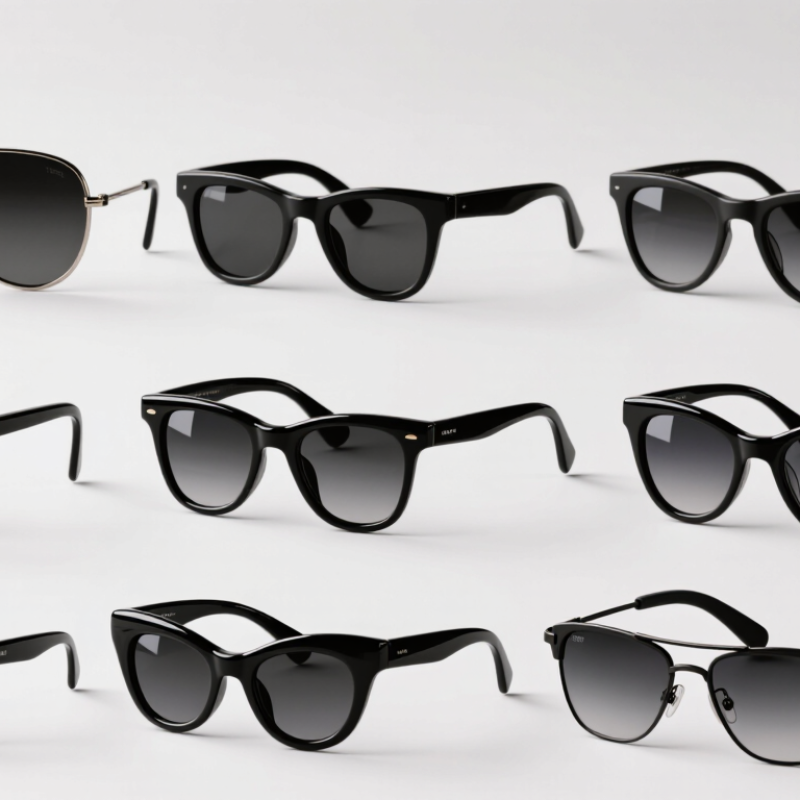
Aviator frames offer a double-bridge structure and broad coverage, which suits buyers seeking a confident, balanced appearance. Wayfarer-inspired frames provide thicker rims and clearer facial definition, especially on oval or round faces. Cat-eye designs lift the outer corners and create a sharper profile. Oversized frames add visual impact, but they may feel heavy during long outdoor use. Slim rectangular frames look modern and work well with tailored clothing. They can appear severe on narrow faces.

Lens features deserve equal attention. Polarized lenses reduce reflected glare from roads and water, while UV400 labeling indicates protection against ultraviolet wavelengths up to 400 nanometers. The World Health Organization identifies excessive ultraviolet exposure as a risk to eye health, so verified protection should outweigh color alone. Black lenses are not automatically safer. Dark tint without proper UV filtering can be misleading.

Material choice changes daily experience. Acetate-style rims often feel warmer and more substantial, while lightweight polymers may improve comfort in humid climates. A small weakness remains: online fit guides cannot replace physical testing. Buyers should check bridge pressure, temple movement, and lens coverage before ordering large quantities. Some elegant frames simply do not fit everyone.

2026 Top Types of Black Sunglasses for Global Buyers

Black sunglasses are commonly offered in classic wayfarer, aviator, round, cat-eye, and sport-wrap designs. The chart uses internationally recognized visible light transmission ranges for sunglass filter categories, helping buyers compare lens darkness and typical use.

Category 0 is very light, Category 1 is light, Category 2 is medium, Category 3 is dark, and Category 4 is very dark. Category 4 is not suitable for driving. Values are based on the filter classification ranges in ISO 12312-1.

Frame Materials and Lens Technologies for Global Buyers

2026 Top Types of Black Sunglasses for Global Buyers

Black sunglasses remain a strong choice for Man Sunglasses collections because they suit travel, driving, and daily urban wear. Grand View Research estimated the global sunglasses market at USD 20.61 billion in 2023, with continued growth expected through 2030. That expansion raises a practical question: does the frame survive real use?

Acetate offers a dense, polished feel and supports rich black coloring without thin painted layers. Stainless steel and titanium create lighter frames, although their nose bridges need careful adjustment. TR90, a flexible thermoplastic, can handle repeated bending, but quality varies between factories. I have seen attractive samples fail at hinge points after limited testing. That mistake is easy to repeat.

Lens selection deserves stricter attention. Polycarbonate lenses provide strong impact resistance and lower weight, while CR-39 often delivers clearer optical performance. Polarized lenses reduce reflected glare from water, glass, and roads; they do not automatically provide ultraviolet protection. The World Health Organization reports that at least 2.2 billion people have near or distance vision impairment, making optical accuracy more than a cosmetic concern. Buyers should request verified UV400 or equivalent test results, not trust a dark tint alone. Intertek and SGS testing can support batch-level verification, but certificates still require checking for scope, date, and product match. Small details matter.

How to Choose Black Sunglasses by Face Shape and Lifestyle

2026 Top Types of Black Sunglasses for Global Buyers

Black sunglasses are not one universal style; their shape should balance your facial lines. For round faces, rectangular or softly squared frames add useful definition. Square faces often look better with oval, round, or gently curved lenses. Oval faces can test most silhouettes, but frame width should stay close to the cheekbone width. Heart-shaped faces may suit lighter lower rims and medium-width frames. Try them in daylight. A mirror can hide pressure points.

Your daily setting matters as much as face shape. For driving, polarized lenses can reduce glare from wet roads and glass. They may affect some digital screens, so test them before purchase. For cycling or running, wraparound frames need stable nose pads and secure temples. Office-to-commute users may prefer medium-dark lenses for flexible wear. Buyers comparing Sunglasses Men styles should check certified UV protection, lens category, hinge quality, and frame measurements. Dark lenses are not automatically safer.

Measure the bridge and temple length, not only the lens width. The frame should stay stable when you smile or look down. A qualified optician can check fit and lens compliance for your market. I once chose an oversized black frame because it looked dramatic, but it slipped during walking. That choice looked better in photos than real life. Comfort deserves more attention than I usually give it.

UV Protection, Fit, Comfort, and Product Quality Standards

For global buyers in 2026, black sunglasses come in several useful shapes. Classic black acetate frames offer strong visual coverage and everyday durability. Slim metal frames feel lighter and suit formal clothing. Wraparound styles reduce side glare during driving or outdoor work. The best choice depends on face shape, activity, and climate. A dark lens does not guarantee protection. Look for verified 100% UVA and UVB filtering, or UV400 labeling supported by test records.

UV protection should be checked before color or decoration. Ask suppliers for lens test data and clear product specifications. Reliable documentation may reference recognized optical and impact standards, such as ISO 12312-1, where applicable. Lens clarity matters. Hold the glasses toward a straight window frame and check for bending lines. Polarized lenses can reduce reflected glare from water, roads, and glass. They do not replace UV protection. For buyers considering Red Sunglasses, the same requirements still apply.

Fit begins with the bridge. It should rest securely without leaving painful marks. The arms should close gently behind the ears. Nose pads can improve stability in humid weather. Comfort is easy to underestimate. Check hinges, screws, lens edges, and coating consistency under bright light. Quality also shows in balanced weight and smooth movement. Some frames may look perfect but feel tiring after twenty minutes. Even careful inspection can miss hidden weaknesses, so sample testing and supplier verification remain important.

2026 Top Types of Black Sunglasses for Global Buyers? - UV Protection, Fit, Comfort, and Product Quality Standards

Sunglasses Type Typical Lens Shape and Coverage Recommended UV Protection Common Frame Width Fit and Comfort Profile Suitable Lens Materials Key Quality Checks Best Use Cases
Aviator Large teardrop lenses with moderate-to-high eye coverage; usually leaves an open lower rim. UV400 or documented 100% UVA/UVB protection; verify testing to ISO 12312-1, ANSI Z80.3, AS/NZS 1067.1, or an equivalent regional standard. Approximately 135–150 mm front width; lens width commonly 55–62 mm. Works well for medium-to-wide faces. Adjustable nose pads can improve bridge fit, but thin metal temples may create pressure behind the ears. Polycarbonate for impact resistance; CR-39 for optical clarity and light weight; mineral glass for scratch resistance but higher weight. Secure hinge alignment, corrosion-resistant metal, stable nose pads, lens symmetry, and no sharp edges. Daily urban wear, driving, travel, and fashion-oriented outdoor use.
Wayfarer-Style Trapezoidal or softly rectangular lenses with balanced front coverage and medium side protection. UV400 or 100% UVA/UVB protection with a visible compliance marking or test report. Approximately 135–148 mm front width; lens width commonly 48–55 mm. A versatile choice for small, medium, and broad face shapes when the bridge and temple length are correctly matched. Injected acetate or plant-based acetate for structure; polycarbonate or CR-39 lenses for lower weight. Consistent frame thickness, smooth finishing, strong hinge rivets, accurate lens seating, and resistance to frame warping. General lifestyle wear, commuting, retail collections, and unisex product ranges.
Round Circular or oval lenses with moderate coverage and a smaller effective brow shield. UV400 or verified 100% UVA/UVB protection; dark lens color alone must not be treated as proof of UV protection. Approximately 125–145 mm front width; lens width commonly 45–53 mm. Often suits angular faces. Small round frames may feel tight on broad faces, while adjustable pads help improve bridge stability. CR-39 for optical quality; polycarbonate for impact resistance; lightweight stainless steel for thin frames. Accurate circular lens alignment, secure nose bridge, smooth rim finishing, and uniform black coating or plating. Lifestyle fashion, indoor-outdoor transitions, travel, and smaller-face size assortments.
Cat-Eye Upswept outer corners with medium-to-high frontal coverage; side coverage depends on temple design. UV400 or independently verified 100% UVA/UVB protection. Approximately 130–148 mm front width; lens width commonly 48–56 mm. Generally flattering on oval, heart-shaped, and round faces. The upswept corners should not touch the cheekbones. Acetate or high-quality injected plastic for shape retention; CR-39 or polycarbonate lenses. Symmetrical corner geometry, smooth edge polishing, secure hinges, stable temples, and accurate color consistency. Fashion retail, occasion wear, lifestyle collections, and medium-width face profiles.
Rectangular Horizontal lenses with broad frontal coverage and a structured brow line. UV400 or documented 100% UVA/UVB protection, supported by regional product testing. Approximately 135–155 mm front width; lens width commonly 52–60 mm. Suitable for round or oval faces. Wider versions need correctly sized temples to avoid outward pressure. Acetate for a premium solid feel; injected nylon or polycarbonate for lighter everyday products. Frame flatness, lens centering, hinge durability, temple straightness, and resistance to surface scratches. Business-casual wear, city commuting, prescription-compatible designs, and broad face sizes.
Wraparound Sport Curved lenses with high frontal and side coverage to reduce peripheral glare and wind exposure. UV400 or verified 100% UVA/UVB protection; impact and optical requirements should match the intended sport category. Approximately 135–150 mm front width; lens width commonly 58–72 mm. Best for active use when the frame has a secure nose grip, non-slip temples, balanced weight, and adequate ventilation. Polycarbonate or impact-resistant nylon lenses; TR-90 or similar lightweight frame materials. Impact resistance, secure retention, lens curvature accuracy, anti-fog ventilation, sweat resistance, and replaceable components. Cycling, running, hiking, beach activities, and high-glare outdoor environments.
Browline Prominent upper frame with smaller lower lens rims; medium eye coverage and strong brow definition. UV400 or documented 100% UVA/UVB protection with applicable regional compliance evidence. Approximately 130–148 mm front width; lens width commonly 48–56 mm. Provides a stable upper frame for many medium faces; the brow bar should sit comfortably without pressing the forehead. Acetate or injected nylon brow section with polycarbonate or CR-39 lenses; metal reinforcement may improve durability. Secure brow-to-rim connection, even lens spacing, stable bridge, clean molding, and reliable hinge performance. Retro-inspired fashion, daily wear, optical-style collections, and medium-size unisex assortments.
Buyer Quality Notes: UV400 is commonly used to indicate protection against ultraviolet wavelengths up to 400 nanometres, but buyers should request test documentation rather than rely only on lens darkness or printed claims. Frame and lens dimensions are typical commercial ranges and should be confirmed through product drawings, physical samples, and regional compliance testing. Sunglasses are not a substitute for certified safety eyewear where industrial or high-impact protection is required.

Regional Trends, Sourcing Factors, and Buyer Considerations

Black sunglasses remain a practical category for global buyers, but regional demand is becoming more specific. Grand View Research valued the global sunglasses market at approximately US$20 billion in 2023. It also projects steady growth through 2030. Growth does not mean every style will sell equally.

In North America, buyers often request polarized lenses, larger frames, and premium metal details. European retailers increasingly examine recycled materials, repairability, and packaging reduction. In Asia-Pacific, lightweight frames, narrow silhouettes, and adjustable nose pads suit fast-moving urban markets. A Sunglasses Man buyer profile may prefer classic black wayfarer shapes, but younger customers often seek slim, geometric designs. Trends shift quickly.

Sourcing decisions need evidence, not attractive samples alone. Request UV400 test reports, lens transmission data, hinge-cycle testing, and material declarations. The International Organization for Standardization provides relevant eyewear testing standards, including ISO 12312-1 for general sunglasses. Buyers should also verify factory consistency through pre-shipment inspections. Small defects matter. Uneven hinges and cloudy lenses create returns.

Grand View Research identifies Asia-Pacific as a strong growth region, yet its forecasts are not purchase guarantees. MOQ, lead time, tariff classification, and replacement-part access can change the real margin. Ask for colorfastness results on black coatings, especially for hot and humid markets. Packaging should protect lenses without adding unnecessary volume. I would not approve a large order from one sample alone. That approach feels cautious, but it prevents expensive surprises.

Retro Tortoiseshell Acetate Sunglasses from China’s Premium Factories with Dark Green Lenses

Retro tortoiseshell acetate sunglasses from China’s premium factories bring together classic craftsmanship and a distinctive modern silhouette. Made from high-quality acetate sourced from reliable suppliers, the frame offers impressive durability, scratch resistance, and a refined feel. Its rich tortoiseshell pattern creates a warm vintage impression, while alternative shades such as deep amber, sleek black, and translucent tones provide versatile styling options. Over time, the acetate can develop a subtle patina, giving each pair an individual character.

The bold octagonal shape adds visual interest without sacrificing everyday wearability. A thick front creates a confident, fashion-forward profile, while carefully engineered hinges help maintain a stable and comfortable fit throughout the day. Dark green lenses complement the warm tortoiseshell tones and lend the sunglasses a sophisticated, understated appearance. Designed for consumers seeking quality directly from the factory, this combination of durable materials, precise construction, and timeless color coordination suits city commutes, weekend travel, and relaxed outdoor occasions.

FAQS

What defines black sunglasses in 2026?

They combine a dark visual identity, verified eye protection, comfort, and practical design. Darkness alone is not enough.

Do black lenses automatically protect against ultraviolet light?

No. Buyers should verify 100% UVA and UVB protection through testing documents. Dark tint without filtering can mislead buyers.

What do polarized lenses offer?

Polarized lenses reduce glare from wet roads, water, and glass. Test them with digital screens before ordering large quantities.

Which black frame shapes suit different faces?

Rectangular frames add definition to round faces. Curved frames can soften square faces. Oval faces usually allow more shape choices.

What should buyers check for driving or outdoor activities?

Drivers may prefer polarized lenses for reflected glare. Runners need stable nose pads, secure temples, and sufficient lens coverage.

Which materials change the wearing experience?

Acetate-style frames often feel warmer and more substantial. Lightweight polymers may feel easier in humid climates. Metal can provide a slimmer profile.

Are oversized black sunglasses practical for long wear?

They offer broad coverage and strong visual impact. However, they may feel heavy after several hours. Dramatic is not always comfortable.

What measurements matter before a bulk purchase?

Check bridge width, temple length, hinge strength, and lens coverage. The frame should remain stable when you smile or look down.

Can online fit guides replace physical testing?

Not completely. Online measurements help, but they cannot reveal pressure points or slipping. I would test one sample first.

Conclusion

In 2026, Black Sunglasses combine timeless visual appeal with practical protection, comfort, and adaptable design. Popular styles include classic aviators, rectangular frames, round shapes, cat-eye profiles, sporty wraparound models, and minimalist geometric designs, each offering a different balance of fashion and function. Buyers can choose from lightweight acetate, durable metal, flexible recycled materials, and hybrid constructions, while polarized, UV-blocking, gradient, and photochromic lenses support different outdoor needs and lighting conditions.

For global buyers, selecting Black Sunglasses should involve more than appearance. Frame proportions should complement face shape, while lifestyle, climate, activity level, and wearing time should guide lens and construction choices. Reliable products should provide strong UV protection, accurate fit, smooth hinges, comfortable nose support, clear lenses, and consistent quality control. Regional preferences, seasonal colors, packaging expectations, order quantities, customization options, shipping conditions, and product documentation also influence sourcing decisions. A balanced approach helps buyers secure sunglasses that are stylish, functional, comfortable, and suitable for diverse markets.

Liam

Liam

Liam is a seasoned marketing professional with extensive expertise in the eyewear industry. With a background in technology-driven manufacturing and global sales, he has devoted himself to enhancing the online presence of his company through insightful and engaging content. Over the years, Liam has......
Previous Why Choose Bamboo Sunglasses for Your Brand?